
Introduction
Manufacturers evaluating productivity, cost efficiency, and product consistency eventually face the decision between semi-automatic vs fully automatic assembly line systems. This choice goes far beyond equipment selection—it directly impacts scalability, workforce dependency, quality consistency, and long-term operational risk. Many organizations fail to recognize how deeply this decision influences overall production performance.
Semi-automatic systems are often perceived as flexible and cost-effective during early growth stages, while fully automatic lines are associated with high output and minimal human involvement. However, the trade-offs are not straightforward. Variables such as product complexity, demand fluctuations, and acceptable defect rates play a critical role in determining the right approach. A poorly aligned decision can result in bottlenecks, idle capacity, or inconsistent product quality. This article outlines the practical differences, operational challenges, and decision criteria required for selecting the appropriate assembly strategy.
Operational Architecture and Process Flow
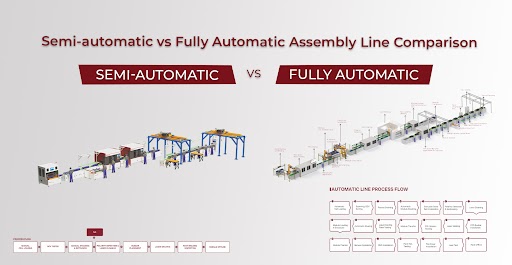
The key distinction in semi-automatic vs fully automatic assembly line systems lies in task allocation between human operators and machines. Semi-automatic setups depend on manual intervention for loading, positioning, or intermediate handling, while machines perform defined repetitive tasks. Fully automatic systems integrate all stages—feeding, processing, inspection, and transfer—into a continuous, coordinated workflow.
In practical terms, this affects process reliability. Semi-automatic systems introduce variability at each manual step, especially in precision-driven sectors such as battery manufacturing or electronics assembly. Fully automatic systems reduce this variability but demand consistent inputs and precise system calibration.
Core structural differences include:
- Semi-automatic: independent stations with operator involvement
- Fully automatic: interconnected systems controlled by PLC or SCADA
- Semi-automatic: easier to modify and reconfigure
- Fully automatic: fixed workflows optimized for continuous production
A common misconception is that automation automatically improves efficiency. In reality, if upstream processes are unstable, full automation can scale defects rather than eliminate them.
Cost Structure and Capital Allocation
The cost comparison in semi-automatic vs fully automatic assembly line decisions is often reduced to initial investment, which is misleading. A more accurate evaluation considers total cost of ownership (TCO), including labor, maintenance, downtime, and yield losses.
Semi-automatic systems require lower upfront capital but involve higher ongoing labor expenses. They also carry indirect costs due to variability, such as rework and inconsistent cycle times. Fully automatic systems demand significant initial investment for integration, programming, and commissioning, but they reduce long-term operational costs.
Important cost considerations include:
- Dependence on labor versus automated output
- Maintenance requirements and spare part management
- Energy usage and system utilization levels
- Product yield and defect-related losses
A flawed assumption is that automation always reduces costs. In environments with low volume or high product variation, fully automatic systems may remain underutilized, making them economically inefficient. The right decision depends on production stability, not just budget.
Throughput, Scalability, and Production Stability
Throughput is where the difference between semi-automatic vs fully automatic assembly line systems becomes most evident. Fully automatic lines are built for uninterrupted operation, delivering significantly higher production rates. However, this advantage depends on stable demand and standardized product designs.
Semi-automatic systems offer lower throughput but greater adaptability. They can handle product variations, design updates, and batch production without extensive reprogramming or tooling changes. This flexibility is essential in industries with evolving product requirements.
From a scalability standpoint:
- Fully automatic systems scale efficiently with volume but struggle with variation
- Semi-automatic systems scale through additional labor but face efficiency limits
Production stability is equally important. Fully automatic lines require consistent input quality; variations in materials or components can disrupt the entire system. Semi-automatic lines are better at managing these inconsistencies due to human oversight.
If demand is unpredictable or product designs are still evolving, investing in full automation too early can create operational constraints rather than advantages.
Quality Control and Defect Management
Quality performance differs significantly between semi-automatic vs fully automatic assembly line systems, but not always in expected ways. Fully automatic systems deliver consistent results, but only when processes are already optimized. They replicate both strengths and weaknesses with high precision.
Semi-automatic systems allow human judgment during inspection, which can help identify irregularities that automated systems may overlook. However, this introduces variability and inconsistency across operators and shifts.
Key quality considerations include:
- Fully automatic: high consistency but sensitive to setup and calibration issues
- Semi-automatic: flexible inspection but prone to human error
- Automated inspection improves detection accuracy but adds complexity
- Manual inspection offers adaptability but lacks repeatability
A critical issue is defect propagation. In fully automatic systems, a single upstream error can impact large volumes before detection. Semi-automatic systems may catch defects earlier but lack systematic prevention mechanisms.
Automation without process validation often results in faster production of defects rather than improved quality.
Flexibility and Change Management
Flexibility is a major advantage of semi-automatic systems compared to fully automatic ones. In industries with frequent design changes or customization requirements, rigid automation can become a limitation.
Semi-automatic lines can be adjusted quickly with minimal downtime. Operators can modify workflows, handle exceptions, and integrate new components without significant system changes. Fully automatic lines require reprogramming, tooling updates, and sometimes hardware modifications even for minor changes.
This directly affects:
- Speed of product development and market introduction
- Cost and complexity of engineering changes
- Risk during product transitions
The trade-off is clear: flexibility versus efficiency. Fully automatic systems are designed for stable, high-volume production, not rapid change. If product lifecycles are short or innovation is continuous, excessive automation can slow operations instead of improving them.
Ignoring this often leads to costly system modifications or underutilized assets.
Decision Framework for Manufacturers
Selecting between semi-automatic vs fully automatic assembly line systems requires a structured, data-driven approach rather than assumptions or trends. The decision must reflect actual production conditions and business goals.
A practical evaluation framework includes:
- Stability of production volume: consistent vs variable demand
- Product design complexity and frequency of changes
- Labor availability and cost dynamics
- Quality expectations and acceptable defect levels
- Investment capacity and expected return timelines
There is no universally superior option. Semi-automatic systems are often more suitable for early-stage scaling, pilot production, or high-mix environments. Fully automatic systems are justified only when processes are stable, volumes are high, and variability is minimal.
Adopting automation without process maturity leads to inefficiencies at scale.
Conclusion
The comparison between semi-automatic vs fully automatic assembly line systems is often misunderstood. This is not a choice between basic and advanced technology—it is a strategic decision that must align with production realities. Fully automatic systems deliver maximum efficiency under controlled conditions but require stability, precision, and long-term commitment. Semi-automatic systems provide flexibility and lower risk but come with limitations in scalability and consistency.
The critical mistake is making this decision based on short-term cost considerations or competitive pressure. Successful manufacturers treat automation as a phased process—first stabilizing operations, then scaling with confidence. Without a solid foundation, automation will magnify existing issues rather than resolve them.